|
|
Whale Watching EcoTours |

Puerto Rico's west and northwest coasts are host to humpback whale visits starting in early December through early March.
BIOLOGY
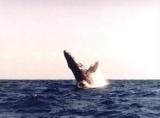 Humpback
whales belong to a group of marine mammals known as Cetaceans. Cetaceans include whales, dolphins and porpoise.
There are two types of Cetaceans. Those with teeth are called Odontocetes like killer whales and dolphins and those
without teeth are called Mysticetes or baleen whales including the great whales such as right, bowhead, blue, fin,
humpback and grey. Baleen whales travel in pods (groups of 2 or more whales). Baleen whales filter their food through
baleen plates that hang down from the roof of their mouths like a comb and are fringed on the inside to capture
their food (primarily krill, capelin and herring).
Humpback
whales belong to a group of marine mammals known as Cetaceans. Cetaceans include whales, dolphins and porpoise.
There are two types of Cetaceans. Those with teeth are called Odontocetes like killer whales and dolphins and those
without teeth are called Mysticetes or baleen whales including the great whales such as right, bowhead, blue, fin,
humpback and grey. Baleen whales travel in pods (groups of 2 or more whales). Baleen whales filter their food through
baleen plates that hang down from the roof of their mouths like a comb and are fringed on the inside to capture
their food (primarily krill, capelin and herring).
Physical features- 45 -50 ft long, and 45 - 50 tons when full grown Babies or calves are about 15 ft at birth and
weigh 3000lb
Humpback whales are distinguished from the other great whales by their extremely long pec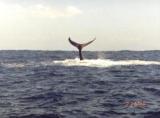 toral fins. hence their latin name Megaptera
novaeangliae "big winged, New Englang" (where from Humpbacks migrate to PR) .
toral fins. hence their latin name Megaptera
novaeangliae "big winged, New Englang" (where from Humpbacks migrate to PR) .
Individual whales are identified by unique patterns on the underside of their flukes or tails, like a thumb print.
This is how animals were tracked to determine their primary migration routes. Scientists continue to use fluke
patterns to study behavior. Color on the underside of tails varies from all black to all white.
Age-
Humpbacks live to be between 40 and 60 yrs old. Inexact science determined by waxy ear plugs with lines representing
seasons or years, like a cross section of tree trunk. Baleen plates in the mouth also show similar lineage. Whales
reach sexual maturity at 6 - 8 yrs and physical maturity at 10- 12 yrs. Calving is every 2 -4 years.
EVOLUTION
Modern whales and dolphins date back 25 - 30 million years. Humpbacks evolved
from an ancient hoofed terrestrial herbivore. They are actually related to camels and hippos.
STATUS and CONSERVATION
| Status-
Humpbacks occur in all oceans of the world. The world population before the whaling days is thought to have been
@ 200,000. This estimate is based on whaling ship logs during the early whaling days (early 1800s). The main reason
whales were hunted was for oil to light lamps throughout Europe. Today there are less than 10,000 humpbacks world
wide. That is a 95% reduction in their population in less than 200 yrs. After 35 million years of existence in
the oceans, humpbacks are on the brink of extinction. Conservation- Humpbacks have been protected by law since 1966 under the Marine Mammal Protection Act. There is a global moratorium on whale hunting agreed to by the International Whaling Commission. Despite this Norway, Japan and Iceland still hunt whales commercially. The #1 threat to all whales now is deterioration and loss of habitat due to marine pollution. 3 billion pounds of garbage are dumped every year into our oceans. Toxic chemicals, especially those that mimic hormones, PCBs (plychlorobyphenols), and dioxin (produced in pesticides, wood preservation, burning organic waste), are prevalent in the ocean ecosystems and cause a wide range of problems. Developmental problems such as deformations, reproductive problems that render animals infertile and cancer are common problems in marine animals throughout the world. |
Enjoy Whale Watching in Western Puerto Rico!..
Go to home page